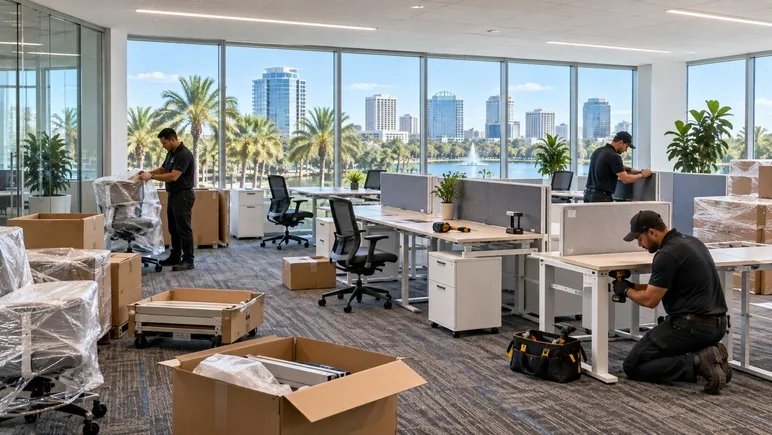
A weekend installation that goes wrong does not stay a weekend problem. If your crew leaves Monday morning with cubicles half-built and aisles blocked, your team cannot work and your morning is gone. Before that scenario becomes yours, contact 360 Modular Furniture Installations at (407) 286-1030 to schedule a planned, zero-downtime install.
Orlando facility managers running corporate campuses, medical office buildings, and multi-tenant floors along the I-4 corridor know the calculus well: furniture work that spills into Monday morning costs far more than the installation itself. Departments miss deadlines. IT cannot reconnect workstations. The building manager fields complaints before nine. A weekend modular furniture installation is the right solution, but only when it is sequenced correctly. Here is how professional crews approach it and why that sequencing is the difference between a Monday morning that works and one that does not.
How Should Delivery and Staging Be Sequenced Around Business Hours?
The single biggest mistake in a self-managed weekend install is treating delivery and installation as the same event. They are not. Furniture that arrives at 7 a.m. Saturday and needs to be broken down, sorted, and staged before a single panel goes up means the crew spends the first three hours of the work window doing logistics instead of building. That compression almost always pushes completion into Sunday evening, which is far too close to Monday morning for comfort.
A professional crew separates the two phases. Delivery is confirmed for the Friday evening window after the last employees leave the floor, or in some cases for the very early Saturday morning hours before traffic on the Orange Blossom Trail corridor builds. Components are sorted by zone and placed as close to their final destination as the floor layout allows. This means that when the installation team arrives Saturday morning, every panel, connector, and tile is already in the right quadrant of the floor. Build time starts immediately rather than after a long staging delay.
Sequencing also accounts for elevator access. Many Orlando office buildings restrict freight elevator use to specific windows, and those windows do not always align with a crew's preferred schedule. A professional installer confirms freight access hours with building management at least a week in advance, identifies whether a loading dock reservation is required, and plans the delivery drop sequence so that no single elevator run becomes a bottleneck. These logistics conversations happen before the weekend, not during it.
How Do You Protect Occupied Areas and Common Spaces During the Installation?
Most weekend installs do not happen on a completely vacant floor. Neighboring tenants may have weekend staff. The lobby and main corridors stay active. A security desk is usually staffed. Protecting those occupied areas is both a liability issue and a professional obligation, and it requires a protection plan that is drawn up before the first panel is unboxed.
Floor protection goes down on every path from the freight entrance to the work zone. Elevator interiors get padded. Corner guards go on any drywall corner that a panel cart will pass within two feet of. If the installation crosses a hard-flooring transition into a carpeted area, that transition gets protected and taped before the first piece of furniture rolls across it. None of this is the building's responsibility. It belongs to the installation crew, and a professional team brings the materials to do it without being asked.
Noise and dust management matter too, especially in buildings with HVAC systems that share return air across floors. Panel systems generate cardboard dust and packaging debris that can circulate if not managed. Professional crews bag and remove packaging continuously rather than stacking it for a single end-of-day run. This keeps the work area clear, reduces fire risk in tight staging zones, and means the floor is presentable rather than buried in cardboard when the facility manager does a Saturday afternoon walkthrough.
What Does a Dry Run and Punch-List Walkthrough Look Like Before Monday?
A professional crew does not declare the job done when the last panel snaps into place. The final two to three hours of any weekend installation belong to the punch-list walkthrough, and that walkthrough is structured enough to catch the problems that a tired crew misses after eight hours of physical work.
The dry run comes first. Every workstation gets a chair rolled in and a person seated at it. Sight lines, knee clearance, and monitor height are checked against the layout drawings. Power and data ports are confirmed accessible at each position. If the client provided a furniture specification that calls for a certain tile height or a particular panel orientation, those specs are verified against what is actually built. Discrepancies found Saturday evening cost one reconfiguration. Discrepancies found Monday morning cost a full day of disruption.
The punch list captures anything that needs attention: a panel that sits slightly out of alignment, a tile that did not lock flush, a connector that needs tightening. Items are photographed and addressed before the crew leaves the building. What the facility manager gets Sunday night is not a list of open items. It is a completion report that confirms every workstation is ready to use.
How Does a Professional Crew Absorb the Risk a Self-Managed Install Cannot?
We recently completed a modular furniture installation for an Orlando client during one of the busiest periods their building had seen, with active renovation work happening on adjacent floors at the same time. Their team did not have the bandwidth to manage sequencing, protect occupied corridors, or coordinate with building management around the construction schedule. We handled all of it. The furniture went in, the floor was ready, and their team came back Monday to a workspace that was upgraded and fully operational. That kind of outcome is not possible when the installation is handed to an internal team that is already stretched thin.
The risk a self-managed install cannot absorb is not the physical labor. It is the decision-making under time pressure. When a delivery arrives an hour late and compresses the Saturday window, someone has to recalculate the sequence on the fly. When a freight elevator goes down mid-morning, someone has to negotiate alternative access with building security while the crew keeps working. When a component is damaged in transit, someone has to assess whether the build can proceed around it or needs to stop. Professional installation crews make those calls without pulling the facility manager away from whatever else they are managing that weekend. That absorption of risk is exactly what the fee pays for.
If you are planning a weekend office furniture project in Orlando and need it done right before Monday, call 360 Modular Furniture Installations at (407) 286-1030 or request a scheduled installation. We coordinate the delivery sequencing, floor protection, and punch-list walkthrough so your team walks in Monday morning to a workspace that is ready to use.